
About All Tours Stargazing ToursSunset ToursHalf Day ToursFrom Puerto de la CruzBuggy ToursQuad Bike ToursHiking Tours Directions Hours & Fees Guides
Find Tours 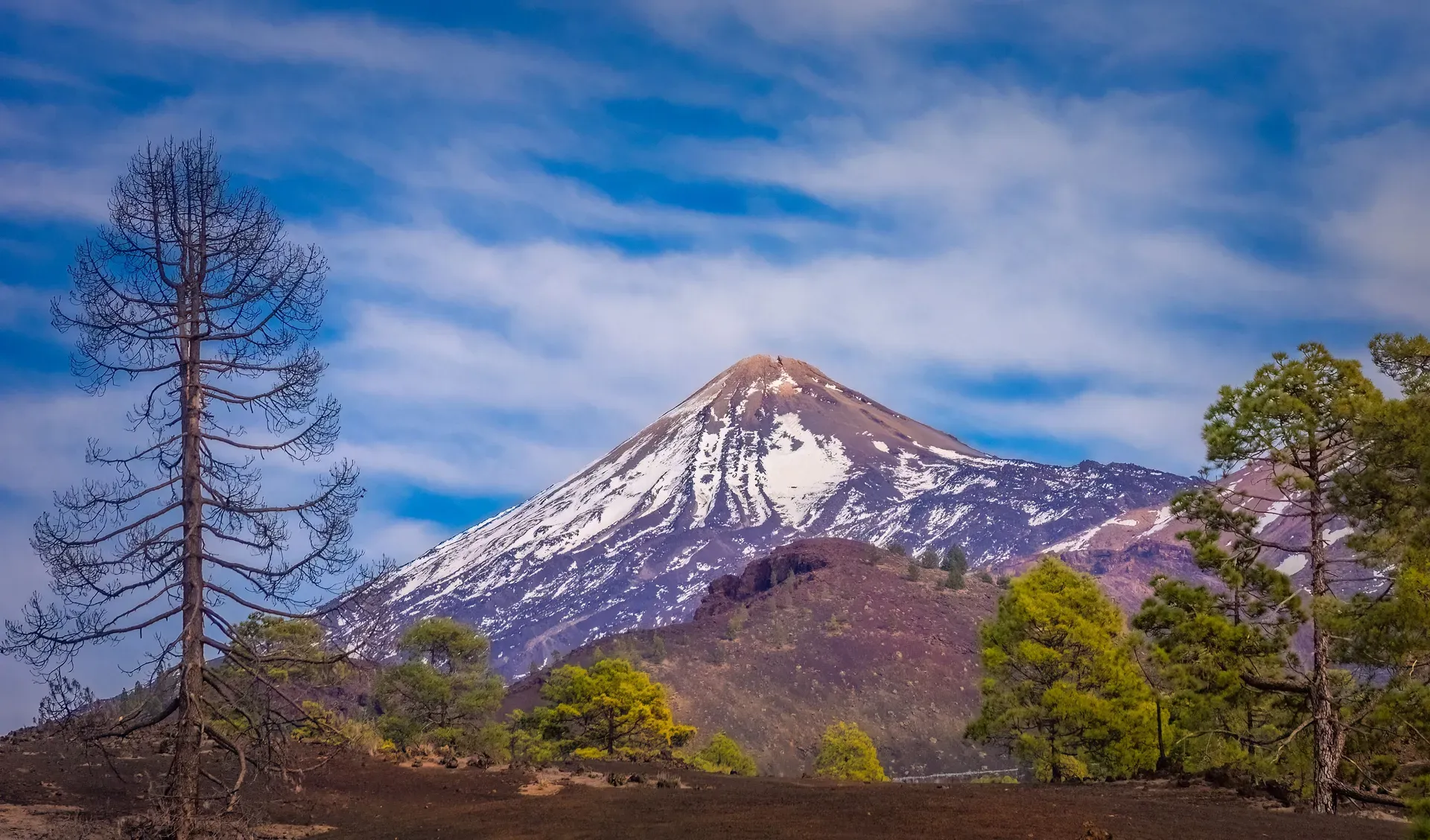
You'll ride a cable car 1,199 vertical metres up Spain's tallest stratovolcano in under eight minutes, trading 30-degree coastal heat for near-freezing winds. The thin air at 3,555 metres leaves you breathless, but watching the mountain cast its shadow across the ocean is worth the chill.
Find Guided ToursMount Teide is an active stratovolcano on Tenerife and Spain's highest point at 3,715 meters. Measured from its base on the Atlantic Ocean floor, it rises 7,500 meters. That makes it the third-tallest volcanic structure on Earth, behind Hawaii's Mauna Kea and Mauna Loa. It forms the centerpiece of Teide National Park, a protected zone covering 189.9 square kilometers of lava fields and volcanic cones.
The mountain formed roughly 170,000 to 190,000 years ago following a catastrophic landslide. It sits atop an older basaltic shield volcano, with its base resting inside the eroded Las Cañadas caldera at an elevation of 2,190 meters. These slopes support unique high-altitude ecosystems. Endemic species like the Teide violet and Teide lizard live directly among the rocks. The park also encloses Pico Viejo at 3,135 meters. Together, they are the only Canary Island summits above 3,000 meters.
Long before the first recorded ascent in 1582, the aboriginal Guanches called the volcano Echeyde. They believed it was a gateway to hell. According to myth, the demon Guayota kidnapped the sun god Magec and hid him inside the crater, until the supreme god Achamán intervened and imprisoned the demon. The volcano remains active today. Teide's most recent eruption occurred on November 18, 1909, venting from El Chinyero.
Spain established Teide National Park on January 22, 1954. UNESCO designated it a World Heritage Site in 2007, recognizing its exceptional volcanic geology. Today, the mountain draws around 4 to 5 million visits a year. That volume makes it the most-visited national park in Europe.


Discover the full history and cultural significance on our About page.
The Teide Cable Car clears 1,199 vertical meters in under eight minutes. You board at 2,356 meters and step out at La Rambleta at 3,555 meters. Watch the massive Cañadas caldera and the Atlantic Ocean drop away through the cabin windows. Book a slot before 11am to beat the queues.
The Telesforo Bravo trail is steep, thin on oxygen, and requires a permit booked months ahead. It gets you to the true summit at 3,715 meters. Walk past steaming sulfurous fumaroles and rare Teide edelweiss rooted in volcanic soil. The altitude hits hard up here, so pace yourself.
Just 4.5 kilometers from the cable car, the Roques de García trail circles a cluster of eroded volcanic towers. The wind-sculpted Roque Cinchado frames perfectly against Teide's western face. It takes about an hour to walk the flat loop. Hit this spot at sunrise for the best light.
Ride the cable car up late in the day to watch the sun sink below the Atlantic. From 3,555 meters, the volcano casts a massive shadow stretching across the ocean toward Gran Canaria. Afterward, stay at the base station to use long-range telescopes with Starlight-certified guides.
Choose from tours starting at $47.41 that include hotel pickup, small group options, and free 24-hour cancellation.
Swipe to see more
 Free Cancellation 8h
 Free Cancellation
 Free Cancellation 6h 30min
 Free Cancellation 9h 30min Free Cancellation 8h Free Cancellation Free Cancellation 6h 30min
 Free Cancellation 6h 30min Free Cancellation 8h Free Cancellation Free Cancellation 6h 30min
 Free Cancellation 2h 30min
 Free Cancellation 2h 30min
 Free Cancellation 9h
 Free Cancellation 3h
 Free Cancellation
The sweet spots for visiting Mount Teide are spring and autumn. You get stable weather, clear views of neighbouring islands, and far less competition for cable car tickets and summit permits.
Stable high-pressure weather and comfortable temperatures clear the air for long-range views of neighbouring islands. Red Tajinaste wildflowers bloom across the caldera, and permit competition drops.
Lower elevations bake in the heat while the year's heaviest crowds pack the park. Securing a cable car slot or a PNT-10 summit permit means fighting intense competition.
Conditions mirror spring with settled weather and excellent visibility across the Atlantic. Crowds thin out considerably, making it much easier to lock down cable car times and mandatory trail authorizations.
Snow, ice, and high winds regularly hit the 3,715-metre peak. These harsh conditions frequently force sudden closures of both the cable car and the summit trails with little notice.
Teide National Park has no gates. The roads and viewpoints stay open 24 hours a day, year-round. Visitor centres like Cañada Blanca and El Portillo operate daily from 9:00am to 4:00pm, though Cañada Blanca closes on December 25, January 1, and January 6. The Teide Cable Car runs daily starting at 9:00am. Closing times shift with the seasons. From January 1 to March 27 and October 25 to December 31, it closes at 5:00pm, with the last ascent at 4:00pm. Summer hours (July 1 to September 30) stretch to 6:40pm, pushing the final ascent to 5:40pm. Spring and mid-October use intermediate schedules.
| Category | Price |
|---|---|
| Park Entry | Free |
| Cable Car Return (Non-resident Adult) | €43.00 |
| Cable Car Return (Canary Resident Adult) | €10.75 |
| Cable Car Return (Non-resident Child 3-13) | €21.50 |
| Cable Car Return (Canary Resident Child 3-13) | €5.38 |
| Cable Car One-way (Non-resident Adult) | €23.50 |
| Cable Car One-way (Canary Resident Adult) | €5.88 |
| Summit Trail PNT-10 Permit (Non-resident) | €15.00 |
| Summit Trail PNT-10 Permit (Canary Resident) | €6.00 |
| Summit Trail PNT-10 Permit (Tenerife Resident / Under 16) | Free |
Cable car tickets are only sold online and frequently sell out days in advance during peak season. Book a morning slot before 11:00am to avoid the worst queues. If you plan to hike the final PNT-10 trail to the crater, you must secure a permit through the Tenerife ON website. These slots open 56 days ahead, releasing every Monday at 07:00 Canary Islands time. The summit fee applies during cable car operating hours and is only refunded if official weather closures block the trail.
For complete schedules and ticket prices, visit our Hours & Fees page.
Most visitors reach the volcano by driving up the TF-21 or TF-38 mountain roads from the coast. Public buses run once a day, so guided tours or private transfers fill the gap for anyone without a rental car.
📍 Teide National Park, TF-21 and TF-38, Tenerife, Canary Islands, Spain
Driving gives you the freedom to pull over at caldera viewpoints whenever you want. Head north on the TF-1 motorway before turning onto the TF-21 or TF-38. From coastal scrubland, the road climbs up through thick pine forests until you hit bare volcanic rock. Parking at the cable car base station is free during operating hours. Just arrive early because the lot fills fast.
Two public bus routes serve the park. You'll just have to plan carefully around their strict schedules. Line 348 leaves Puerto de la Cruz and passes through La Orotava. Meanwhile, line 342 departs from Costa Adeje and winds up via Vilaflor. Each route runs exactly once a day with a single morning departure and an afternoon return trip.
Booking an organized tour removes the stress of driving up steep mountain roads. Operators like Volcano Teide run dedicated bus trips picking up directly from major coastal resorts. You'll get an official guide. The driver stops at the Roques de García rock formations before dropping you at the cable car. Skip the car rental if you prefer this route.
Pre-booking a transfer gets you from the airport to the volcano fast. Drivers take the TF-1 and TF-38 directly to the cable car base station at 2,356 meters. It costs significantly more than a rental car, so solo travelers shouldn't bother with this option. But a group splitting the fare might find the door-to-door convenience worth the high price tag.
For detailed transport options and routes, visit our Directions page.
Apply for the PNT-10 summit trail permit via tenerifeon.es exactly 56 days before your trip. The park releases new slots every Monday at 07:00 Canary Islands time. They'll sell out days in advance. If you miss out, you can still ride the cable car to La Rambleta at 3,555 meters.
The cable car operator explicitly bans sandals, heels, wedges, and flat-soled shoes. Boarding requires closed, high-grip hiking or sports shoes. Pack layers, too. Temperatures at the upper station often hover near freezing even when the coast is 30°C, and the high-altitude UV requires strong sunscreen.
High winds or ice can shut down the cable car and summit trails with just a few hours' notice. This happens most frequently between December and March. Always check the official 'Teide Today' status page and the AEMET mountain forecast before leaving your hotel. If your summit slot gets canceled, email for a refund.
Book a cable car time slot before 11:00 am to beat the worst of the midday rush. The base station car park at 2,356 meters is entirely free. But spaces fill up fast. Arrive before 9:00 am or after 5:00 pm during peak season so you aren't stuck waiting for a spot.
The thin air at 3,555 meters carries real risks of altitude sickness. Park rules strictly prohibit children under three, pregnant women, and anyone with heart or respiratory conditions from riding the cable car. Wheelchair users face similar restrictions. Safe evacuation within regulation time simply can't be guaranteed.
Recreational drone flights are completely banned across the entire 189.9 square kilometers of the national park. Spanish aviation authorities enforce this strictly. Unauthorized flights have resulted in fines reaching several thousand euros. Don't risk it. Stick to the marked paths with a standard camera.
These eroded volcanic pinnacles sit right across from the historic Parador hotel. Walk the 4.5-kilometer circular trail to see the wind-sculpted Roque Cinchado. The rock stands directly in front of Teide's western face.
Stop at this historic town on the northern route down from the volcano. Mansions from the 16th to 19th centuries line the streets, displaying ornate wooden balconies. Locals build elaborate volcanic-sand carpets here for Corpus Christi.
A winding mountain road leads to this steep ravine village. Hikers tackle the famous gorge trail, which requires a permit. Further south, 600-meter sheer rock walls drop straight into the ocean.
Read what travelers share about their experience visiting Mount Teide — from practical tips to personal highlights.




Planning advice, comparisons, and practical tips.

Teide National Park packs a one-hour stroll among volcanic rock towers and a seven-hour grind to Spain's highest point into the same 190 square…

At 3,715 metres, Mount Teide is the highest point in Spain, and after dark it turns into one of the clearest windows onto space anywhere in Europe.…

Mount Teide hasn't erupted since 18 November 1909, when lava broke from the El Chinyero vent on its northwest flank. That fact alone doesn't stop…
Entry to the park itself and driving its roads is free. You only pay for specific activities like the cable car, which costs €43 for a non-resident adult return ticket.
Yes. The final PNT-10 trail from the upper cable car station to the 3,715 m crater requires a permit booked through the Tenerife ON website. It costs €15 for non-residents, and slots open 56 days in advance every Monday at 07:00.
The cabin climbs 1,199 vertical meters in under 8 minutes. Most people spend about an hour total between boarding, the ascent, and walking the viewpoint trails at the top.
TITSA operates two daily routes: line 348 from Puerto de la Cruz and line 342 from Costa Adeje. Each runs just once up in the morning and once down in the afternoon. A single ticket costs between €3 and €5.
Aim for April to June or September to November. These months offer clear visibility and lighter crowds than the July and August peak. Winter visits run the risk of sudden trail and cable car closures from snow and ice.
The operator strictly enforces a footwear policy. You must wear closed, high-grip shoes, so leave the sandals, heels, and flat soles at your hotel. Pack a windproof jacket and sunscreen because the air at 3,555 meters is cold and highly reflective.
No. Park rules explicitly ban wheelchairs and visitors with motor impairments from riding because a safe evacuation cannot be guaranteed within the regulation time. Ground-level spots like the El Portillo Visitor Centre offer accessible packed-gravel paths to viewpoints instead.
Recreational drones are entirely prohibited everywhere in Teide National Park. Unauthorized flights carry fines of several thousand euros under Spanish aviation laws.
Browse verified tours with free cancellation and instant confirmation.
Find Tours


